
Direct flights from Tashkent, $30 buses, and an EU safety ruling are helping turn a quiet alpine lake into one of Central Asia’s fastest-growing beach-and-mountain getaways.
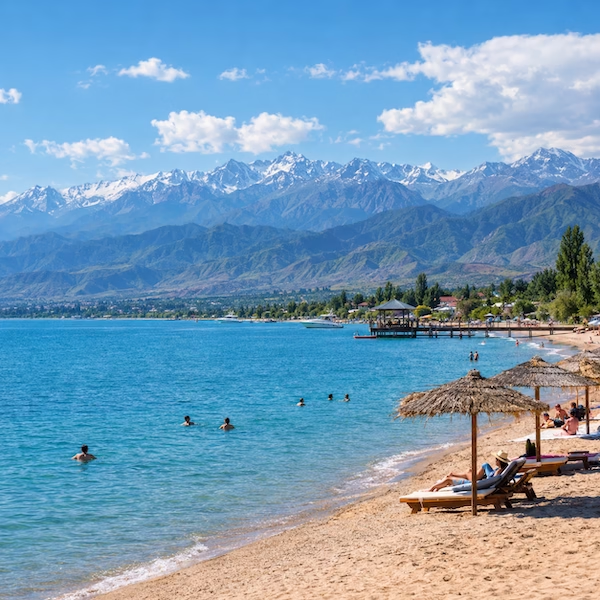
A few years ago, Lake Issyk-Kul still felt off the radar. Today, it is becoming one of the main destinations in a rapidly expanding Central Asian tourism market.
President Sadyr Japarov said in July 2026 that Kyrgyzstan’s annual tourist flow had reached roughly 13 million, compared with just 2 to 3 million before 2020 and 2021.
That is a four- to six-fold increase in a handful of years, and the lake in the Tian Shan mountains sits in the middle of it.
From 2 Million Visitors to 13 Million
About 10 million tourists came to Kyrgyzstan in 2025, and tourism officials say they spent more than $1 billion. Official statistics recorded 10.509 million foreign arrivals that year, although that figure represents entries into the country rather than 10.5 million unique tourists.
Tourism officials say the sector now accounts for more than 5% of the country’s GDP. National Statistical Committee national-accounts data put tourism’s direct contribution closer to 4%, reflecting differences in how tourism’s economic contribution is measured.
The government wants to increase tourism’s contribution further. The tourism agency has discussed a target of 7.5%, while the government’s formal tourism development programme targets 7% by 2030.
When a target like that gets set, infrastructure money follows, and investment in the Issyk-Kul region is expected to keep growing.
The lake has already moved quickly. By the end of the 2025 tourism season, the number of food-service establishments around Issyk-Kul had risen from 360 in 2019 to 963.
Nearly three times as many restaurants, cafés and other food-service businesses in six years, driven by rising regional and international demand.
Neighbours explain part of it. Kazakhstan reported 15.7 million foreign visitors in 2025, with 11.1 million of them qualifying as tourists.
Uzbekistan logged 6.56 million foreign visitors in the first half of 2026, up roughly 25% year over year. Regional demand is accelerating, so spillover into Kyrgyzstan is likely to continue.
Uzbekistan Now Sends Over 60% of Foreign Arrivals
One market does much of the heavy lifting. Uzbekistan is by far Kyrgyzstan’s largest source of international visitors.
In 2025, Uzbek citizens accounted for around 6.57 million of Kyrgyzstan’s 10.51 million foreign arrivals — roughly 63%. The figure is based on border entries, rather than unique holidaymakers, so some individuals may have entered more than once.
Visa-free travel and close geographic proximity make the crossing relatively easy. For Uzbek travellers, Issyk-Kul is increasingly accessible as a cross-border holiday destination rather than a once-a-year trip.
That kind of repeat regional traffic changes what gets built along the shore, from guesthouses to larger lakeside resorts.
New Transport Links and an EU Aviation Breakthrough
Reaching the lake got cheaper and easier this year. In July 2026, a direct flight route launched between Tashkent and Issyk-Kul International Airport in Tamchy.
Asman Airlines operates it in partnership with Uzbek tour operator Malva Tour. Flights run once a week on Wednesdays.
The flight takes about 1 hour 20 minutes, with round-trip fares starting at $160.
A month earlier, in June 2026, the seasonal passenger bus service between Tashkent and Cholpon-Ata returned for the summer. Uzautotrans Service operates the route using Yutong buses.
Tickets cost about $30, with departures on even-numbered days and returns on odd-numbered days during the summer season.
The route itself is not new — seasonal Tashkent–Cholpon-Ata bus services have operated in previous years — but its continued operation gives travellers another low-cost way to reach the lake.
Europe got an opening too. The EU removed all Kyrgyz air carriers from its Air Safety List in June 2026, recognizing improvements in the country’s aviation safety oversight.
That removes a major regulatory barrier to potential direct air services between Kyrgyzstan and EU destinations.
It does not mean that direct Europe–Issyk-Kul flights are already operating. But Kyrgyz airlines are no longer subject to the EU-wide restriction that previously prevented them from operating commercial services into the European Union.
When You Should Actually Go
Issyk-Kul is no longer an off-radar destination. It is becoming one of Central Asia’s fastest-growing beach and mountain getaways.
Expanded transport links, growing accommodation options, and a rising visitor count are shifting the lake away from its budget backpacker image toward a more developed lakeside destination.
If you are planning a trip, here is what changed:
– Fly: Tashkent to Tamchy, weekly on Wednesdays, from $160 return.
– Bus: Tashkent to Cholpon-Ata, about $30, with even-day summer departures.
– From Europe: Kyrgyz carriers are no longer on the EU Air Safety List, removing a major barrier to potential future direct services.
Timing still matters more than money. Early autumn usually brings smaller crowds than the peak summer weeks, while lake temperatures can remain comfortable for swimming.
You get the lake without quite the same peak-summer crush.
The window will not stay open long. With Kyrgyzstan’s tourist flow expanding from a few million annual visitors to figures in the 10–13 million range, the quiet version of Issyk-Kul is already behind us.