
Transport Minister Talantbek Soltobaev has proposed completing the feasibility study for an alternative route through Uzynagash and Kemin, cutting the drive from 460 kilometres to 277 and saving about two and a half hours.
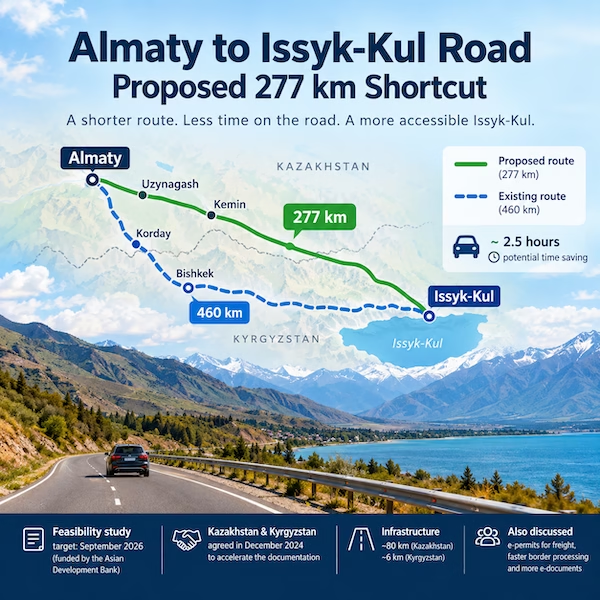
Issyk-Kul is close enough to Almaty for a weekend. The road does not always feel that way. Kazakh travellers currently take a route of roughly 460 kilometres through Korday and Bishkek before reaching the lake.
On 15 September 2026, Kyrgyz Transport Minister Talantbek Soltobaev raised the proposed alternative route again, calling for the feasibility study to be completed. The proposed corridor would connect Almaty with Issyk-Kul through Uzynagash and Kemin, reducing the route to about 277 kilometres.
But this is still a proposed road, not a construction project that has been approved. The feasibility study is an important step because it must establish whether the shortcut is technically and economically viable before the two countries make a final decision on implementation.
From 460 Kilometres to 277: What Changes on the Map
The existing Almaty–Issyk-Kul journey runs through Korday and Bishkek. The proposed alternative would head west of that route, passing through Uzynagash and Kemin, before continuing towards Issyk-Kul.
The difference is substantial: about 277 kilometres instead of 460.
Earlier project estimates suggested the shorter route could save around two and a half hours compared with the existing journey. The actual travel-time saving would, of course, depend on road conditions, border processing and the final route selected by the feasibility study.
The infrastructure requirements are also very different on each side of the border. Current project information indicates that Kazakhstan would need to upgrade approximately 80 kilometres of existing roads, while the Kyrgyz section would involve roughly 6 kilometres.
The proposed shortcut therefore isn’t simply a new road across the mountains. Much of the work would involve upgrading existing infrastructure and creating the necessary connection between the two countries.
And there is a reason the feasibility study matters so much. The mountain terrain, winter conditions, construction costs, traffic volumes and economic return all have to be assessed before the project can move forward.
The Project Has Already Hit a Pause
The 277-kilometre road is not a brand-new idea.
Kazakhstan and Kyrgyzstan agreed in December 2024 to accelerate preparation of the project’s documentation, with the feasibility study targeted for completion in September 2026. The Asian Development Bank is financing the study through grant funding.
Kazakhstan subsequently created an interdepartmental working group to coordinate the project. It includes representatives from the ministries responsible for the national economy, ecology and transport, the Border Service of the National Security Committee, and the Atameken national chamber of entrepreneurs.
But progress has not been completely straightforward.
In April 2026, reports said the project had been put on hold amid questions about its economic viability. The difficult mountain terrain and the challenges of operating the route during winter were among the issues raised.
That makes the September development significant, but it does not mean construction is about to begin.
Soltobaev’s latest proposal is essentially a push to finish the feasibility work and establish whether the project should proceed.
Freight and Border Queues Are Part of the Picture
The 15 September meeting also covered another issue that matters to anyone travelling between Kazakhstan and Kyrgyzstan: the border.
Soltobaev and Kazakh Ambassador Abylkair Skakov discussed introducing an e-Permit system for cross-border freight vehicles. Kyrgyzstan already uses electronic freight permits with China, Uzbekistan, Azerbaijan and Turkey.
The two sides also discussed reducing processing times for passengers and baggage at border crossings and expanding the use of electronic documentation along the Kyrgyz-Kazakh frontier.
That matters because a shorter road does not automatically mean a shorter journey. If border queues absorb the time saved on the road, part of the advantage disappears.
For travellers from Almaty, however, the potential is obvious. A direct 277-kilometre corridor would remove the large detour through Bishkek and could make Issyk-Kul considerably more accessible for short trips.
The takeaway: the Almaty–Issyk-Kul shortcut is back on the agenda, but the road has not yet been approved for construction. The feasibility study is the next major step. It needs to determine the route, costs, traffic potential and economic viability before Kazakhstan and Kyrgyzstan decide whether to proceed.
If the project eventually moves forward, the proposed 277-kilometre corridor could dramatically change the road journey from Almaty to Issyk-Kul.