
No working group or timeline exists yet. Here’s what one regional visa could actually change for a beach-and-Silk-Road trip.
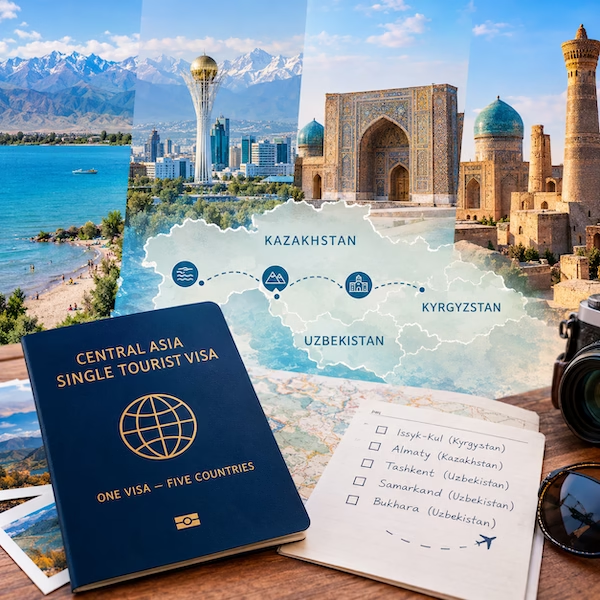
A swim in Lake Issyk-Kul in the morning, a walk through Samarkand’s Registan a few days later. That trip is already possible. What makes it complicated is that Central Asia still has separate national entry systems.
A tourist planning to swim at Issyk-Kul and then explore Almaty or Samarkand currently has to deal with the immigration rules of each country separately. On July 31, 2026, Kyrgyz President Sadyr Japarov told regional leaders that it does not necessarily have to stay that way.
Speaking at an informal summit in Cholpon-Ata, on the shores of Lake Issyk-Kul, Japarov again promoted the idea of a single tourist visa for Central Asia. Kazakhstan and Uzbekistan supported the proposal.
It is not a regional visa yet. There is no launch date, finalized agreement or published application system.
But if the idea becomes reality, it could make multi-country trips through Central Asia considerably simpler.
What One Visa Could Change for Your Itinerary
The proposed visa is intended to work on a Schengen-style model, allowing a tourist to obtain one regional travel authorization rather than arranging separate visas for participating countries.
That could make it much easier to combine a Central Asian beach holiday with a Silk Road itinerary.
Issyk-Kul already provides the summer beach component. The lake attracts visitors for its beaches, swimming, hot springs and mountain scenery, with Cholpon-Ata one of the main resort towns on the northern shore.
Add Kazakhstan or Uzbekistan to the same trip and the itinerary becomes a multi-country Silk Road circuit rather than a single-country holiday.
The important word is could. The governments have not yet published the final rules, so nobody can say exactly how applications, fees, validity periods or border procedures would work.
Two Routes That Could Work If It Goes Live
- Beach, city, Silk Road. Fly into Bishkek, spend a week around Issyk-Kul, continue to Almaty for city sightseeing and mountain day trips, then fly to Tashkent and continue to Samarkand and Bukhara.
- Beach and mountains in two countries. Combine Issyk-Kul with Uzbekistan’s Chimgan mountains for hiking and summer mountain activities, creating a beach-and-mountains itinerary before continuing to Tashkent and the historic cities.
Neither route requires new infrastructure. The roads, buses and flights already exist.
What a regional visa could change is the administrative side of the journey: how many separate visa applications a traveler needs and which national visa rules apply before departure.
It would not necessarily mean that passport checks disappear at the borders. A common visa and a Schengen-style border-free travel area are two different things.
Would It Matter If You Are Already Visa-Free?
Yes, but probably less.
Kazakhstan currently allows visa-free stays of up to 30 days for citizens of many European countries, the United States, United Kingdom, Canada, Australia and other countries. Kyrgyzstan also has visa-free arrangements covering citizens of many Western countries, with the permitted stay depending on nationality. Uzbekistan allows U.S. citizens to enter visa-free for up to 30 days.
For a traveler who is already visa-free in Kyrgyzstan, Kazakhstan and Uzbekistan, a common tourist visa would therefore not suddenly make the trip visa-free or remove ordinary border formalities.
Its bigger effect would be on travelers who currently need visas for one or more countries in their itinerary.
For them, the attraction is straightforward: instead of navigating several national visa systems, the proposed arrangement could provide one regional application covering multiple participating countries.
Exactly how that would work remains undecided.
Two Neighbors Back It, But No Timeline
Regional visa simplification has been discussed before.
In 2018, Kazakhstan and Uzbekistan promoted the idea of a “Silk Road Visa”, modeled partly on Europe’s common visa arrangements. The initiative did not become an operational regional visa.
Japarov revived the idea in March 2025. At the July 2026 meeting in Cholpon-Ata, Kazakhstan and Uzbekistan publicly supported the renewed proposal.
The other Central Asian countries have not all signed onto it.
Tajikistan already operates an electronic visa system and has expanded visa-free access for numerous nationalities, but I found no public announcement that it has endorsed the new common Central Asian visa.
Turkmenistan remains particularly separate from the region’s increasingly simplified tourist-entry systems. Most Western tourists still require a visa to visit, although Turkmenistan established a legal framework for electronic visas in 2025.
That leaves the exact shape of any future regional system unresolved.
There is also no publicly announced implementation timetable. No operational application system, final visa rules or launch date has been published, and the practical details — including how participating countries would coordinate the system — still have to be worked out.
So if you’re planning a Central Asian trip for summer 2027, budget and plan around the visa and visa-free rules that exist for each country today. Don’t book an itinerary on the assumption that a regional visa will be available by then.
Check the rules again shortly before booking and before departure.
If the common visa arrives early, your paperwork may become simpler.
But for now, it’s a proposal, not a travel document.