
Divers Mapped Streets, Buildings and a Muslim Cemetery Beneath Kyrgyzstan’s Largest Lake — and UNESCO Has Offered to Send Scientists
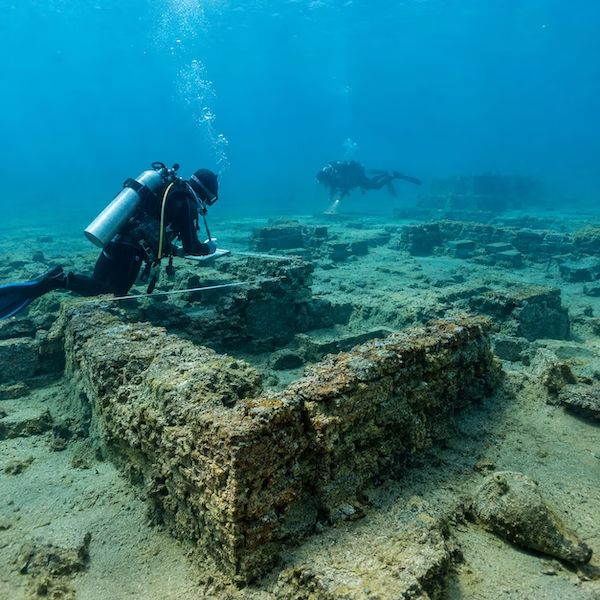
Somewhere in the northwestern waters of Lake Issyk-Kul, a medieval town lies beneath the surface. Researchers have been mapping its remains since at least 2023.
On October 6, 2026, researchers reported on the latest work at the submerged settlement of Toru-Aigyr, following a 2026 field season conducted in phases.
That is a scientific milestone. It is also a travel one.
Kyrgyzstan’s signature summer lake now carries an underwater archaeology story that few destinations in Central Asia can match.
What the Divers Found Under the Water
The Toru-Aigyr complex sits in the lake’s northwestern waters. It represents a large settlement that existed from at least the 10th to 13th centuries, before being submerged in the 15th century.
Earlier phases of the expedition documented building remains, archaeological deposits and a Muslim cemetery dating to the 13th–14th centuries. Researchers have also identified surviving brick structures, foundations and sections of ancient walls beneath the lake.
The work has come in stages. Two 2025 phases ran across July and then September–October. A first phase followed in summer 2026, and the September fieldwork formed the second phase of that year’s research.
Three organizations are involved in the expedition: Kyrgyzstan’s Institute of History, Archaeology and Ethnology, Russia’s Institute of Archaeology, and the Russian Geographical Society, which supports the research.
During the fieldwork, divers and researchers conducted underwater surveys, documented archaeological structures, collected artifacts and gathered samples from the submerged cultural layer. The research is also helping scientists investigate how the settlement came to lie beneath the lake.
The site remains largely unexplored. Researchers estimate that only 15–20% of the archaeological complex has been surveyed.
That leaves substantial work ahead. Scientists are investigating possible explanations for the submergence, including sudden ground movement associated with an earthquake and gradual flooding linked to tectonic changes affecting the lake. The exact cause has not been conclusively established.
That matters beyond academia. Further research and documentation could eventually give museums, guides and tour operators a better-supported account of the town and its history.
UNESCO Is Ready to Send Scientists
Four days before the October 6 report, the site picked up wider institutional attention.
On October 2, 2026, UNESCO Director-General Khaled El-Enany expressed readiness to send scientists and researchers to Kyrgyzstan to study ancient settlements, including underwater sites. The commitment followed a meeting in Paris with Kyrgyz parliamentary speaker Marlen Mamataliev.
The announcement concerns archaeological cooperation across Kyrgyzstan. A specific UNESCO scientific mission to Toru-Aigyr has not been confirmed, and no dedicated visitor-infrastructure project has been announced.
For travelers, Issyk-Kul is already Kyrgyzstan’s signature summer destination. Its underwater archaeological discoveries add another dimension to the lake’s appeal, alongside diving, historical tourism and Silk Road heritage circuits.
Accessible mountain-lake beaches paired with the remains of a submerged medieval settlement offer a distinctive combination for Central Asia.
Right now, there is no confirmed underwater museum or marked dive trail over the ruins. What exists is a documented archaeological site, an active research program and a lake that already draws summer visitors.
The discovery could also contribute to Kyrgyzstan’s broader efforts to diversify tourism beyond mountain trekking. However, commercial diving opportunities and visitor facilities at the archaeological site remain unconfirmed.
That makes Toru-Aigyr a potential future attraction for archaeology enthusiasts, divers and history-minded travelers alike, although its tourism potential has yet to be established.
If you are weighing an Issyk-Kul trip, the lake is not only about the beach. Part of its history lies beneath the surface, and researchers have surveyed only a fraction of what may be there.