
Japarov’s plan would let travellers pair an Issyk-Kul beach holiday with Uzbekistan’s Silk Road cities and Azerbaijan’s Caspian resorts on a single authorization. Here is what is real, what is missing, and why summer 2027 is too soon to count on it.
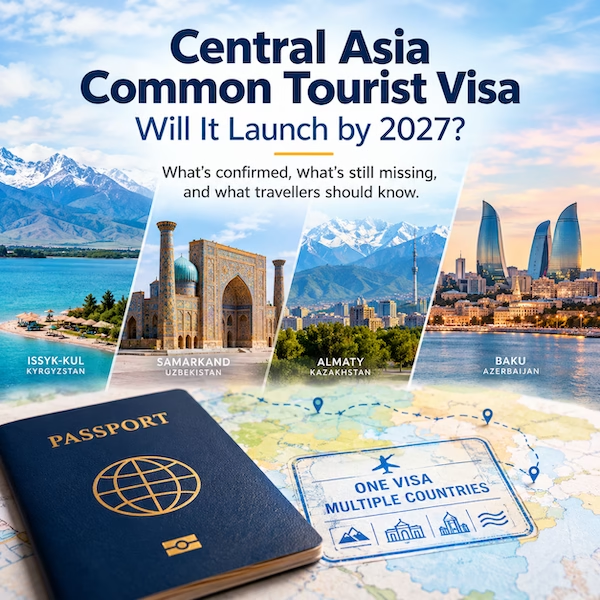
Imagine swimming in Lake Issyk-Kul on Monday, standing in the Registan in Samarkand on Wednesday, and finishing the week on Baku’s Caspian waterfront. One travel document instead of three separate visa applications.
That is the trip Kyrgyz President Sadyr Japarov sketched on October 8, 2026, at the Consultative Meeting of the Heads of State of Central Asia with Azerbaijan’s participation, held in the Avaza Tourist Zone in Turkmenbashi, Turkmenistan. He proposed introducing a common tourist visa for the Central Asian countries and Azerbaijan.
How a Single Regional Visa Would Work
The model is Schengen-style. One regional travel authorization replaces separate national visas, so you clear entry once for the whole bloc rather than country by country.
For Issyk-Kul specifically, that would make multi-country trips far easier. You could swim in the lake, then continue on to Almaty or Samarkand without arranging new entry paperwork.
Japarov’s argument is that these countries have different but complementary tourism potential, ranging from historic cities and mountain areas to numerous cultural heritage sites. He proposed a “one trip, several countries” model built on joint tourist routes.
He also called on the foreign ministries of all participating countries to prepare specific proposals for introducing the common visa. That instruction is where the concrete detail currently stops. No implementation timeline, no fee structure, and no application mechanism have been published yet.
Why Azerbaijan’s Inclusion Changes the Map
This is the first time Azerbaijan has been explicitly included in the unified-visa proposal. Previous backing came from Kazakhstan and Uzbekistan at the July 31, 2026 informal summit in Cholpon-Ata, on the shores of Lake Issyk-Kul.
The addition of Azerbaijan fundamentally expands the geography of the proposed visa. A traveler could theoretically combine a beach holiday at Lake Issyk-Kul with Silk Road city tours in Uzbekistan and a Caspian Sea resort stay in Azerbaijan on a single authorization.
For summer travellers, the practical implication is significant:
– Kyrgyzstan already provides the beach-and-mountain component at Issyk-Kul.
– Kazakhstan adds Almaty’s urban amenities and the Charyn Canyon.
– Uzbekistan brings Samarkand, Bukhara, and Khiva.
– Azerbaijan contributes Baku’s Caspian coastline, Gobustan’s mud volcanoes, and the mountain resort of Shahdag.
Today, entry rules vary sharply across that same route. Kyrgyzstan offers up to 60 days visa-free for EU, US, UK, Japan, and South Korean citizens. Kazakhstan offers 30 days visa-free for similar passport holders. Azerbaijan operates an e-Visa system, ASAN Visa, with a three-day turnaround for most nationalities, plus visa-free entry for some CIS and Gulf states.
Issyk-Kul Is Already the Testing Ground
Azerbaijan and Kyrgyzstan have direct tourism investment ties that predate the visa talk. The five-star Baku Resort & Spa opened on Lake Issyk-Kul on July 31, 2026, in Kara-Oy village, developed under a 2023 intergovernmental agreement between the two governments.
The resort was inaugurated by the presidents of Azerbaijan, Kyrgyzstan, Uzbekistan, Kazakhstan, Tajikistan, and Turkmenistan. Six heads of state cutting one ribbon is a fairly clear signal about where the region wants tourism to go.
The numbers back that up. Kyrgyzstan’s tourist flow reached roughly 13 million annual visitors as of July 2026, up from 2 to 3 million before 2020.
Tourism officials say the sector accounts for more than 5% of GDP, and the government has set a formal target of a 7% tourism GDP contribution by 2030.
The broader context is a Central Asian push toward tourism regionalism. Alongside the visa proposal, Kyrgyzstan has accelerated infrastructure projects including the proposed Almaty-Issyk-Kul 277 km shortcut road and the ongoing development of the Ala-Too all-season mountain resort near Jyrgalan.
What Is Still Missing
Turkmenistan’s role as host is notable in itself. Avaza sits in a country that maintains some of the region’s most restrictive visa policies, so its participation signals at least diplomatic interest in regional tourism integration. Ashgabat has not publicly committed to joining the visa scheme itself.
Beyond the summit statement, there is no machinery behind the idea. No working group has been announced, no draft treaty text published, and no pilot programme outlined. The proposal remains at the diplomatic-initiative stage.
Here is the takeaway worth acting on: do not plan around this being operational for the 2027 summer season. Book Issyk-Kul, Almaty, Samarkand, and Baku as separate legs under today’s rules, and watch what the foreign ministries actually produce. If a common visa lands, the same itinerary gets cheaper and simpler. Until then, the corridor exists on paper.