
Issyk-Kul’s Velvet Season: Warm Autumn Days, Quieter Beaches and Lower Prices
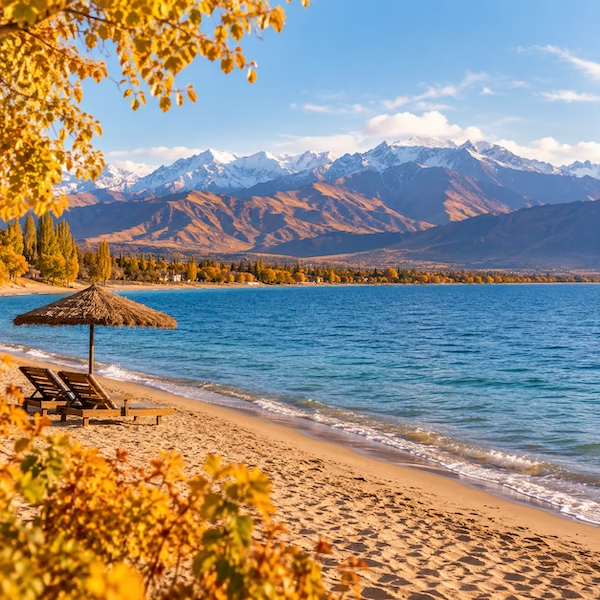
September brings quieter beaches, potentially lower accommodation prices and golden mountain scenery to Issyk-Kul. The catch: this season belongs to travellers who plan ahead.
Ask most visitors about Issyk-Kul and they describe July. Packed beaches, a traffic jam stretching along the Bishkek–Cholpon-Ata highway, guesthouses booked out weeks in advance.
Now picture the same shoreline in September. The mountains above it are turning gold, the beaches are quieter, and you can claim a stretch of sand without arriving before breakfast.
The water may still be warm enough for swimming, particularly in early September, while accommodation prices at some properties fall considerably from peak-season rates. By late September, however, cooler water and changing weather make beach days less predictable.
That window has a name. Very few people plan their trip around it.
The Water Stays Swimmable Longer Than You Might Expect
Issyk-Kul’s water retains some of summer’s warmth into September, making early autumn a potential extension of the swimming season. But timing matters.
In early September, water temperatures can remain around 19–21°C. As the month progresses, temperatures generally decline, with late-September readings potentially falling to around 15–18°C. Conditions vary by location and weather, and early October is less reliable for swimming.
For a swimmer, the difference between early and late September can be significant. You might still enjoy a refreshing dip, but the experience is different from the warmer water of midsummer.
The atmospheric difference is enormous. Cooler air, quieter beaches, mountains beginning to change colour, and fewer people competing for the best stretch of shoreline.
The lake’s thermal properties help it cool gradually. But while daytime conditions can remain pleasant in early autumn, evenings grow colder, particularly as October approaches. Outdoor dining is still possible on suitable days, but warm evenings are no longer something to take for granted.
What Velvet Season Means, and What It Can Save You
The term “velvet season” (бархатный сезон) is borrowed from Black Sea and Mediterranean tourism. It describes the period after peak summer, when visitor numbers decline and the weather can remain pleasant.
At Issyk-Kul, the most useful window for this kind of trip is generally early to mid-September, with late September offering a quieter, cooler alternative.
Here is why it can be a real value proposition rather than just a marketing phrase: some hotels, resorts and guesthouses reduce their rates after the summer peak, while the landscape remains attractive and outdoor activities continue.
The exact savings depend on the property, room type, meal arrangements and travel dates. Some accommodation providers offer substantial reductions, while others maintain higher rates for longer or close for the season. Travellers should compare like-for-like prices rather than assume a uniform discount across the lake.
The crowd difference explains much of the appeal. July and August bring busy beaches, heavier traffic and strong demand for popular guesthouses. By mid-September, many parts of the coastline become noticeably quieter.
Kyrgyzstan’s tourism sector has also continued to attract attention. President Sadyr Japarov referred to a figure of 13 million visitors in 2026, although the reporting period and counting methodology were not clearly specified. The figure should not be interpreted as 13 million unique tourists or as proof that Issyk-Kul received the majority of them.
For travellers, the more immediate point is simple: the busiest summer weeks and the quieter autumn period offer different experiences of the same destination.
The Road Gets Easier Too
Practical logistics often improve outside the summer peak. The Bishkek–Cholpon-Ata highway generally experiences less holiday traffic in September, which can make the journey more relaxed.
Actual driving times depend on your departure point, destination, road conditions and stops, so it is worth checking the route before travelling rather than relying on a fixed journey-time estimate.
Domestic transport can also be less crowded outside peak periods. Marshrutka minibuses and shared taxis may be easier to arrange, although services and departure frequencies vary. Guesthouse owners at properties that remain open may have more time to help with special requests, activity bookings and transfer arrangements.
The transactional friction of peak season can ease considerably. Just remember that quieter does not necessarily mean every service remains available.
Autumn Opens the Mountains, the Orchards and the Light
Cooler air can make outdoor activities more comfortable than during the hottest weeks of summer.
- Horseback trekking in the Chong-Kemin and Kyzyl-Suu valleys can be more pleasant in cooler weather, although conditions vary with altitude and the forecast.
- The walnut forests of Arslanbob become a seasonal attraction during the autumn harvest. Arslanbob is in Jalal-Abad Region, far from Karakol, so it is best treated as a separate destination rather than a short excursion from Issyk-Kul.
- The hike to Altyn Arashan’s hot springs can benefit from cooler temperatures, but the high-altitude trail remains physically demanding. Weather, trail conditions and the availability of transport should be checked before setting out.
Harvest tourism is another reason to consider autumn. September and October are important months for apples and walnuts in parts of Kyrgyzstan, although harvest periods depend on the crop, variety and location. Apricots, by contrast, are generally harvested in summer rather than being a typical September–October crop.
Some rural guesthouses and local hosts may offer seasonal food experiences, fruit picking or traditional food preparation. These are worth asking about when booking, but availability should be confirmed directly rather than assumed across entire villages.
The scenery changes as sharply as the schedule. The Tien Shan mountains above the lake shift from summer green towards gold and rust, while higher peaks may already carry snow.
Morning mist can create mirror-like reflections on the water, particularly on calm days. For photography, it is an opportunity to capture a different side of the lake. The same shoreline can look remarkably different from its midsummer appearance.
Autumn also offers a useful opportunity to explore the region before winter travel and ski-season preparations take centre stage. The light, changing vegetation and snow-dusted mountains can be as rewarding as the summer beach scenery, even when swimming is no longer the main attraction.
What Closes After September, and How to Prepare
Velvet season has real limits, and ignoring them can ruin a trip.
Some restaurants, beach rental services and tourist-oriented businesses reduce their hours or close as summer ends. This is particularly important in smaller villages, where the number of year-round services may be limited. Check opening status in advance and confirm that your chosen guesthouse will be operating on your dates.
Transport needs the same scrutiny. The Bishkek–Balykchy passenger train normally operates on a seasonal summer schedule. In 2026, the main service ran from 26 June through 13 September, with additional departures announced for selected dates later in September and early October. Travellers should check the official railway timetable for the latest schedule rather than assume the service runs throughout autumn.
Nights turn cold quickly, especially away from the shoreline and at higher elevations. Temperatures can approach freezing in some locations by late October, so a light summer packing strategy is insufficient. Bring layers, a warm jacket and suitable footwear, and check the forecast before heading into the mountains.
Swimming plans also need flexibility. Early September offers the best chance of combining beach time with quieter surroundings. By late September and October, the emphasis shifts towards walks, photography, local food and mountain scenery rather than guaranteed swimming weather.