
A Mountain Lake With Global Standards: Why Issyk-Kul’s Blue Flag Push Matters for Travelers and Central Asia
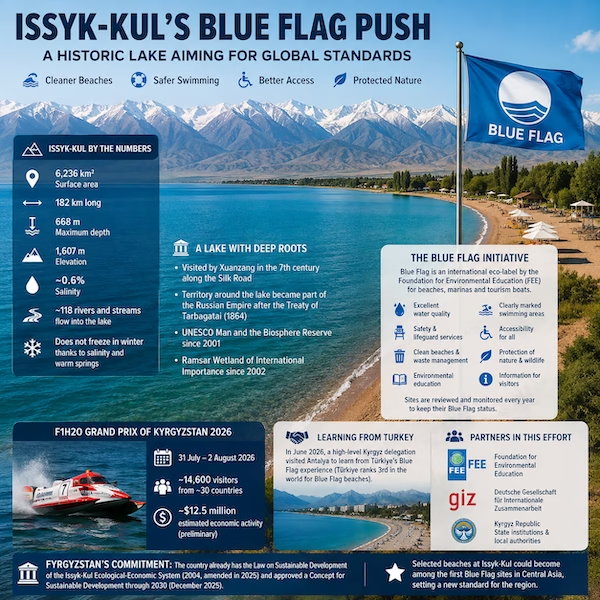
Imagine a high-altitude lake so large it feels like an inland sea, framed by snow-fed peaks and reached by more than a century of Silk Road travellers. Issyk-Kul is one of the world’s great lakes, and now it may add a new distinction: becoming one of the first places in Central Asia to earn Blue Flag certification.
For visitors, this is not just an environmental label. It promises cleaner water, safer beaches, clearer swimming zones, and better access, turning a famous but rugged destination into one that is easier to trust and plan around.
What Makes Issyk-Kul Extraordinary?
At 6,236 square kilometres, Issyk-Kul is the second-largest mountain lake on Earth after Lake Titicaca. It stretches 182 kilometres long and plunges to 668 metres at its deepest point, making it the eighth-deepest lake globally.
The lake sits at 1,607 metres elevation in the Tian Shan mountains of eastern Kyrgyzstan. Its salinity of roughly 0.6% means it rarely freezes, even with cold winters and high altitude. About 118 rivers and streams, fed by glaciers and hot springs, flow into it.
That mix of scale, depth, salinity, and mountain setting gives the lake a character closer to a remote coastline than a typical alpine lake. It has also made Issyk-Kul a travel crossroads for over a thousand years.
The Chinese Buddhist scholar Xuanzang passed by in the 7th century while travelling the Silk Road, placing the lake within one of history’s most important trade and cultural routes. Centuries later, the lake and surrounding territory were ceded to Russia after the Treaty of Tarbagatai.
Today, that layered history sits beside strong international protection. Issyk-Kul has been a Ramsar wetland site since 1975 and a UNESCO Biosphere Reserve since 2000, recognised for globally significant biodiversity.
How Tourism Growth Led to a Blue Flag Bid
Tourism around Issyk-Kul is already accelerating. The F1H2O World Championship stage held on the lake from 31 July to 2 August 2026 drew around 14,600 visitors from about 30 countries. According to preliminary figures from Kyrgyzstan’s State Tourism Development Agency, the event generated an estimated $12.5 million in economic impact.
That kind of attention raises a practical question: how can the lake welcome more visitors without damaging what makes it valuable? The Blue Flag effort is Kyrgyzstan’s answer.
The Blue Flag programme, run by the Foundation for Environmental Education since 1987, is an international eco-certification for beaches, marinas, and tourism boats. It now covers more than 50 countries and is awarded only when strict criteria are met in water quality, safety, environmental management, and public education.
In practice, Blue Flag requires clean, regularly tested water, lifeguard and first-aid services, clearly marked swimming zones, clean territory with waste sorting, wildlife protection, accessible facilities for people with disabilities, and public information boards on local ecosystems. That gives travellers a clear way to judge which beaches meet an internationally accepted standard.
No Blue Flag currently exists in any former USSR country. Selected sites at Issyk-Kul could become among the first in Central Asia to receive the award. Abdulkadir Ateş, Chairman of FEE Turkey, said this would “inspire new success stories in the fields of environment, sustainability and tourism across the Turkic world.”
How Kyrgyzstan Is Learning From Turkey
In June 2026, a high-level Kyrgyz delegation visited Antalya, Turkey, on a study tour to see how Turkish resorts implement Blue Flag. Turkey ranks third worldwide in Blue Flag awards, giving Kyrgyz officials a practical model close to home.
The delegation included Kyrgyzstan’s Tourism Development Agency, the Kyrgyz Association of Tourism Organizations (KATO), the Association of Resorts of Kyrgyzstan (AKK), four pilot resorts, and local Issyk-Kul authorities. It was headed by Nurgazy Esengeldi uulu, First Deputy Head of the Issyk-Kul District Administration.
Observers inspected Konyaaltı and Lara public beaches, plus Blue Flag marinas and tourist boats. They studied water-quality monitoring, lifeguard operations, beach accessibility, waste management, and environmental education, all required Blue Flag criteria. Germany’s international development agency GIZ is supporting the Kyrgyz initiative, while the Foundation for Environmental Education is providing technical guidance for introducing Blue Flag at selected sites around the lake.
What Visitors Can Expect Next
By August 2026, Kyrgyzstan’s Tourism Agency was evaluating a new environmental bill specifically aimed at protecting Lake Issyk-Kul. This signals expanding government attention to the lake’s ecological health alongside the tourism push.
For travellers, the practical benefit is simple. Beaches with a Blue Flag are audited annually for safety and cleanliness, making the certification a globally recognised trust signal. It can make holiday planning easier and set a visible standard for resorts around the lake.
If Issyk-Kul succeeds, it will not just earn a flag. It will show how a historic Silk Road lake can protect its biodiversity while offering visitors a safer, cleaner, and more credible mountain-beach experience. It also gives the region a practical model for responsible growth.